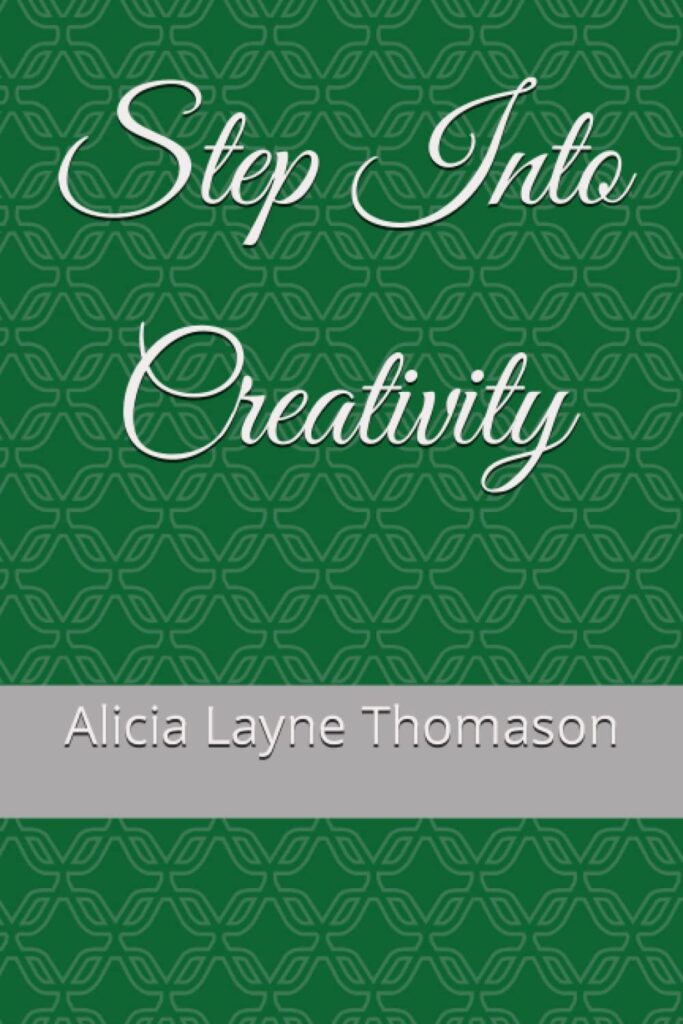
The image you see above is my debut poetry book, Step Into Creativity.
Other than these blog posts, I do very little when it comes to writing nonfiction. But poetry is an exception. It’s been an exception for as long as I have been writing stories. I enjoy poetry as much as I enjoy reading a good fantasy book or writing my own story. You can read all about my love for poetry in one of my earlier blog posts, Writing Poetry.
This post will focus particularly on my first poetry book. For my debut poetry, I wanted to do something special. And what could be so special then to write poems about creativity?
I like my poetry books as having a theme to them. The idea of writing a poetry book with poems spanning a theme of creativity sounded like a lot of fun. And it would be something unique. I had read and written a lot of poems about nature, which I adore, but I wanted something unique. So I wrote the poems that make up Step Into Creativity. And being a Christian poet, it only made sense that I would honor God, the Creator of all things. I started the book with a poem about God creating the world and ended it with a poem celebrating God’s creation.
The first poem was fun to write. This certain poem is a sestina, which, according to Lewis Putnam Turco in his 2011 book The Book of Forms, is a poem in which “the six end-words or teleutons of the lines of the first stanza are repeated in a specific order as end-words in the five succeeding sestet stanzas” (334). So, a poem with six stanzas, then a shorter finishing stanza using all the end-words in one sentence? What a perfect poetry form to write about the biblical account of creation! One stanza for each day of creation. I reviewed the six days of creation, chose my end-words, and voila! The perfect opening sestina for my poetry book.
I’m thankful to God for the creativity He gave me. I wrote about writing my own stories and poems, writing my own musical pieces, my favorite craft stores and a poem about Barnes & Noble, holding booths at craft fairs, and how creativity lifts my mood. But the themes of creativity weren’t limited to only me. I wanted to write about the creativity of others around me, but I kept certain things in my own family, and for general ideas such as the poem that talks about theater dancing, in order to stay within the safest legal bounds. With permission from my family, I wrote about the sewing of clothes and doll clothes of my mom and my sister, the speech and debate works of my other sister, my brother’s drawing of his own comics, artwork from my dad and my grandmother, and a college art show that included works from my distant cousin who contributed to illustrations in my first three Kennedy Ryan books. I also wrote a poem for other people to relate to: the infamous coronavirus pandemic of 2020. I remember reading all over social media how being stuck in boring old quarantine opened up many doors for other people to let out their creativity, and I wanted a poem that the general population could relate to.
Some of the poems I wrote are in free verse, meaning they don’t have any rhymes or a set rhythm. While writing free verse is fun and easy (and could even represent the freedom we have when it comes to creativity), how could I write a poetry book with a theme of creativity without using the creativity of other poetry forms? The creativity of poetry is amazing. The rhymes at the ends of the lines, or even in the middle of the lines. The syllable count for each line. The metaphors, the similes. The unending inspiration for whatever a person can write a poem about!
I’m so thankful for Lewis Putnam Turco’s The Book of Forms. This book was a required textbook for my poetry classes in college. I never let it go. This textbook teaches the reader all about the different poetry forms, from the countless forms of lyric poetry to how to write narrative poetry. I learned about forms I never knew existed. I’m so glad that I took Tami K. Haaland’s poetry classes. I dedicated Step Into Creativity to her, so naturally I wrote a poem about her creative writing classes in a poetry form that she said she loved: the ghazal. Turco describes the ghazal as “an Arabian multiple-couplet form that turns on a single rhyme (qafia) and a refrain (radif)” (224). Each line of the ghazal has fourteen syllables.
To best explain the rhyming scheme, below is an example of the ghazal I wrote:
“As a young student author I could never shun writing/all my life I have always had a lot of fun writing/So I took college classes on fiction and poetry/to study all forms and genres, and I begun writing . . .” (13).
So only the first two-line stanza has a rhyming couplet. The other stanzas make the second line rhyme with the first stanza, but using the same last word (in my case, writing).
Tami also favored sonnets. I’m sure most of us know sonnets because of William Shakespeare. But a Shakespearian sonnet is only one type of sonnet out there. One of my other English teachers described a sonnet as the kind of poem that as long as it has fourteen lines and ten syllables in each line, it’s a sonnet. The Shakespearean sonnet has this rhyme scheme: abab cdcd efef gg.
I think I may have invented a sonnet when I wrote A Song in E Minor, page 81. That sonnet was about a piece of music I wrote for one of my music theory classes in college. And writing a “song”-net about a song? Yeah, I couldn’t resist that pun. Anyway, the rhyme scheme of my sonnet, the form of which I think I will call the Alician sonnet (lol), goes like this: abba cddc effe gg.
(And if this rhyme scheme already exists, then I will admit that I did not invent it!)
The pun that led me to choose a sonnet form brings me to another creative idea for how I write my poems. When it comes to choosing a form for a certain poem, I ask myself, “What are the themes of this poem? Can a form match a certain poem’s theme?” And actually, it can. For example, one of my favorite poems, Depths of Imagination on page 11, is in free verse so that I could scatter the words across the pages (while still ensuring readability of course). The poem starts with a basic stanza of three lines, then the lines and words begin to scatter as the poem talks about me engaging in my imagination while I’m listening to music. I let my imagination roam freely. Only do the lines seem to return to a regular stanza with the words “I wake up just long enough to switch to another song.” Then I let the lines scatter again. This free verse form represents the freedom of exploring the imagination.
For the poem Fairy Forest Decoration on page 27, I chose the Spenserian sonnet, named after Edmund Spenser, author of The Fairie Queene. The Spenserian sonnet’s rhyme scheme goes like this: abab bcbc cdcd ee.
I chose an Irish poetry form for An Irish Song in A Major on page 85. This form is a sneadhbhairdne (sna-vúy-erd-ne) (Turco 2011). Yes, how about a long Irish word that needs a pronunciation guide, eh? Turco describes this poem as a form that “alternates octosyllabic and tetrasyllabic lines, both ending in disyllable words. Lines 2 and 4 rhyme; line 3 consonates with both. Every stressed word in the fourth line must rhyme . . .” (350).
Just like the pronunciation, it wasn’t easy to write, but why take on a challenge it it’s too easy? I like the challenge of firm rhymes and rhythms!
As I mentioned earlier, I wanted to end the book with a poem about God’s creation. An Ode to the Glory of God’s Creation, page 91, is a Keatsian ode. It has ten syllables per line and three stanzas with the rhyme scheme ababcdecde.
So those are examples of the forms I chose for my poems as I wrote them, and how I used my own creativity to get my theme across the poems. You can order my poetry book on Amazon and Goodreads.
I want to finish this post with this: I give glory to God, the Creator of everything, for His gift of creativity to me.
Further reading:
Thomason, Alicia Layne. Step Into Creativity. Alicia Layne Thomason, 2022.
Turco, Lewis Putnam. The Book of Forms: A Handbook of Poetics, Including Odd and Invented Forms. Revised and expanded ed., Dartmouth College Press, 2011.